
Did you know the United States Department of Agriculture offers two programs, ELAP and NAP, to cover honey bee losses? In fact, the USDA has up to $20 million of Commodity Credit Corporation (CCC) funds available for losses under the ELAP program, courtesy of the 2014 Farm Bill.
Table of Contents
What is ELAP?
ELAP, or Emergency Assistance for Livestock, Honey Bees, and Farm-raised Fish, is a USDA program to offer financial assistance to eligible producers of livestock due to losses. For this article, we will only be covering the honey bee portion of the program.
ELAP is essentially insurance for your bees, but there is no premium, deductible or fees. Yes, the program is completely free to join!
Once your bee yard(s) are enrolled, they will be covered for colony loss (just the bees), hive loss (bees and the physical hive), as well as any additional feed purchased (beyond normal quantities) necessary to sustain a colony.
What does ELAP cover?
ELAP offers reimbursements on colony feed, colony loss, and hive loss. The loss must be the result of:
- Colony Collapse Disorder
- Earthquake
- Winter storm
- Wind
- Flood
- Hurricane
- Lightning
- Tornado
- Volcano
- Wildfire
- Adverse weather
For 2018, the USDA will reimburse at least 75% of fair market value, which equates to at least $105 per colony loss and at least $193 per hive loss. Supplemental feeding reimbursement is at least 60% of the actual cost of feed.
Who is eligible?
Almost everyone! There is no minimum to the number of hives one must own to enroll. Honey bees used for honey production, pollination and breeding are eligible. Wild, feral or native bees (i.e. leafcutter or mason) are not eligible.
As long as your adjusted gross income from your hives is less than $900,000 per year and you are a US citizen, you are eligible.
Additional Coverage
Socially Disadvantaged, Limited Resource and Beginning Farmers and Ranchers
The USDA has additional programs that offer certain benefits for beekeepers. Qualification for these programs will allow you to enroll in the NAP program for free.
Those eligible for Socially Disadvantaged (also referred to as Targeted underserved farmer or rancher) certification include women, American Indians or Alaskan Natives, Asians or Asian Americans, Blacks or African Americans, Native Hawaiians or other Pacific Islanders, and Hispanics.
Limited Resource eligibility requirements include those that “Earns no more than $173,600 in each of the two calendar years that precede the complete taxable year before the program year, to be adjusted upwards in later years for inflation; and has a total household income at or below the national poverty level for a family of four, or less than 50 percent of county median household income for both of the previous two years.”
If you have been keeping bees for less than 10 years and have never certified any livestock with the USDA, you are eligible for the Beginning Farmers and Ranchers certification.
Noninsured Crop Disaster Assistance Program (NAP)
Beekeepers are also eligible for NAP, a reimbursement program for financial losses due to low honey yield as a result of:
- Drought
- Freeze
- Hail
- Excessive moisture
- Excessive wind
- Hurricane
- Earthquake
- Flood
- Plant disease
- Insect infestation
Those that qualify for the certifications noted above can enroll in NAP for free. Otherwise, enrollment is $250 per year, which is a small fee considering the amount of honey and income that can be lost in a low production season.
More information
For additional information, please contact your local USDA office.
Additional resources:
2018 ELAP for honey bees fact sheet
2020 ELAP for honey bees fact sheet
USDA Form CCC-870 Colony Collapse Disorder Certification
How to apply
Producers (beekeepers) must apply at your local Farm Service Agency (FSA) Service Center. To find your local office, click here.
ELAP Policy
Part 3 Honeybees
61 General Eligibility
A Eligible Producer
In addition to meeting the definition of an eligible producer, as defined in paragraph 23, an eligible honeybee producer is a producer who has a risk in the honey production, pollination, or honeybee breeding operation for producing honey, pollinating, or breeding honeybees for commercial use as part of a farming operation on the beginning date of the eligible adverse weather or eligible loss condition.
B Eligible Honeybees
Eligible honeybees include bees housed in a managed hive and used for honey production, pollination, or honeybee breeding. Eligible honeybees do not include wild, feral honeybees, leaf cutter bees, or other bee species that are not used for producing honey, pollinating, or breeding honeybees.
C Report of Colonies
All honeybee producers must file FSA-578 by:
· January 2 of the same crop year
Example: January 2, 2019, for losses claimed in 2019 calendar year.
· within 30 calendar days of the date colonies of bees are acquired, split, bought, sold, transported into, or out of the county.
*–Producers will use a manual FSA-578 to report changes to the total number of colonies and/or counties to which bees are moved. Manual FSA-578’s must include the following.
| Item | Entry |
| 1 | FSA FSN where producer’s headquarters is located. |
| 2 | Names and shares of all producers sharing in the colonies for producing honey, pollinating, and/or breeding. |
| 3 | Number of colonies. |
| 4 | Names of counties to which colonies of bees are moved. |
The producer will certify to the number of colonies reported in FSA-578 “Remarks” section.–*
9-4-19 1-ELAP Amend. 2 Page 3-1
Par. 61
61 General Eligibility (Continued)
*–C Report of Colonies (Continued)
Notes: The FSA-578 “Certification Statement” will read as follows:
“I certify the number of colonies reported include all colonies for which producing honey, pollinating, and/or breeding is expected.”
If the total number of colonies increases on a manual FSA-578 during the crop year after the initial automated FSA-578 is filed by January 2, the automated FSA-578 will be revised with the highest number of colonies reported at any time in the crop
year.–*
D Late-File Report of Colonies
A report of colonies submitted beyond the date in subparagraph C may be accepted if COC is satisfied that the report of colonies is accompanied by either of the following to support the conclusion that bees were present in the geographical area at the time of the disaster:
· a copy of the State hive registration when required by State law
· additional supporting documentation, such as moving permits, contracts with growers for pollination, loan documents, and beekeeper financial records.
9-4-19 1-ELAP Amend. 2 Page 3-2
Par. 62
62 Eligible Honeybee Losses A Eligible Losses
To be considered eligible for benefits, an eligible honeybee producer must have suffered a loss of:
· honeybee colonies, as described in subparagraph B
· honeybee hives, as described in subparagraph C
· honeybee feed, as described in subparagraph D.
B Eligible Honeybee Colony Losses
For honeybee losses to be eligible, the honeybee colony must meet the following conditions:
· be maintained for producing honey, pollinating, or breeding honeybees for commercial use in a farming operation on the beginning date of the eligible loss condition, as provided in subparagraph 63 A
· be physically located in the county where the eligible adverse weather or eligible loss conditions occurred on the beginning date of the eligible loss condition
· be a honeybee colony in which the participant has a risk in honey production, pollination, or honeybee breeding farming operation on the beginning date of the eligible loss condition
· be a honeybee colony for which the producer had an eligible loss of a honeybee colony, in excess of the normal honeybee colony mortality rate for the applicable program year as provided in subparagraph 64 D,
· the loss could not have been prevented through reasonable available measures as determined by COC
Notes: Honeybee losses because of controllable conditions, such as varroa mites, is not an eligible loss condition.
Drought is not considered an eligible loss condition for honeybee colony losses.
Loss of income from pollinator contracts because of CCD is not an eligible loss condition under ELAP.
9-4-19 1-ELAP Amend. 2 Page 3-2.5 (and 3-2.6)
Our experience
We completed the application this year (2018), and it was very simple. The agents had the paperwork prepared, and it only took about an hour. It would have been a lot quicker but I asked a ton of questions. We were even able to enroll hives that are in different counties! I hope we do not have to make a claim in the future, but it is reassuring to know that we have coverage if needed. We have lost hives in the past to CCD and nearly lost two hives in two different yards due to wildfire. I highly encourage all eligible beekeepers to apply!
Bonus: Get the beekeepers calendar for free
You’ll find 37 pages filled with detailed information to help you make this the best beekeeping season yet! Stay ahead of upcoming tasks and know what to look for with the guidance of A Years Journey In Beekeeping: The Beekeepers Calendar.
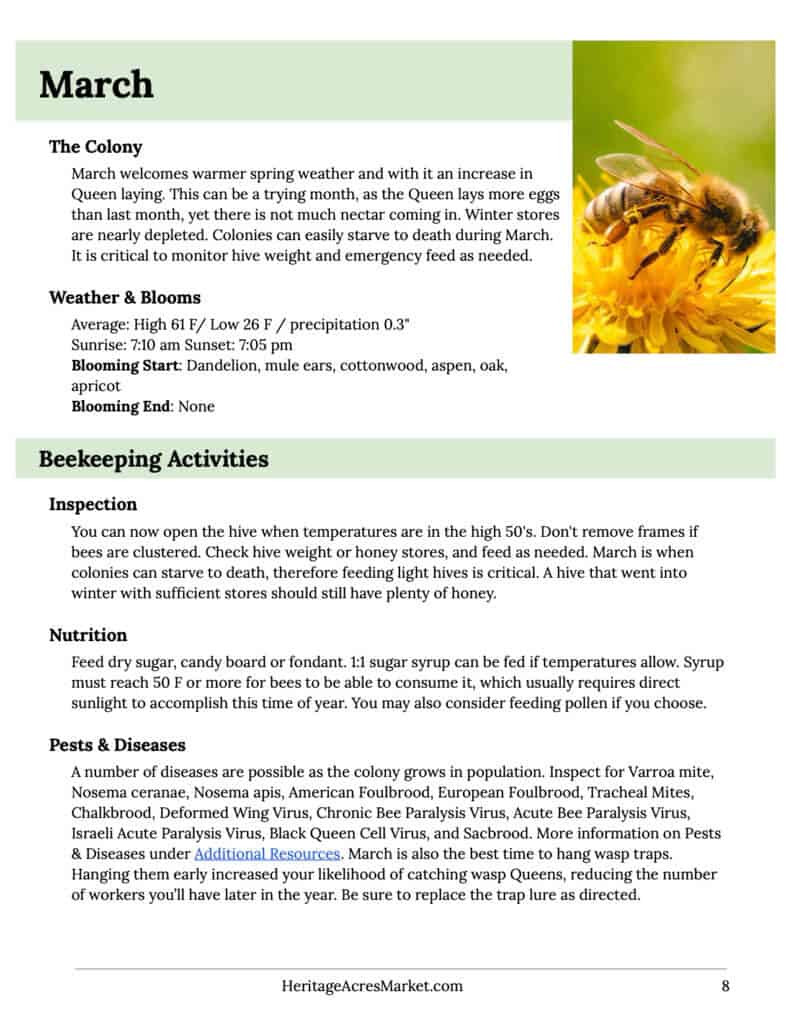
What’s Inside
- 12 months of in depth information addressing key activities and objectives
- A full 4 pages detail common pests and diseases, along with mitigation options
- Additional Resources section lists more than 20 excellent resources for more beekeeping information
- Plus, you’ll obtain access to our Farmstead Google Calendar to help keep you on track
Download your free copy today! Simply fill out the form below and A Years Journey In Beekeeping: The Beekeepers Calendar will be sent right to your inbox.
Note: If you don’t see the email in your inbox, please check your junk folder or search your mailbox for Hello@heritageacresmarket.com